
Master chefs keep it a secret so it is not easy to get hold of it. Actually, how did cevap become a traditional dish in Bosnia and Herzegovina and Serbia after it was taken over from the Ottoman
Empire? There are certainly variations in types of meat used for its preparation. There are alsovariations in t he process of preparation and serving depending on the place of making.
After browsing through numerous tutorials, recipes, secret ingredients that allegedly came to light and that are circulating online and offline – I finally managed to put together something that should be the closest thing to the original, secret recipe.
What Kind of Meat Is Used to Make Authentic Cevapi?
You should use a mixture of meat; however, the base is made of beef to which you can add mutton,lamb or pork. Actually, regardless of the fact that in some places in Serbia they use pork – some arequite adamant that there is no place for pork meat in a genuine cevap. They say that, at first, cevapi were made of mutton only but, in time, in order to become more acceptable to a delicate city folks’ palate the recipe was changed and cevap started to be made of a mixture of meats. For example, a popular combination is the one that has 70% beef and 30% mutton – but it is not a rule.
However, the thing that became a rule is that the meat used for cevapi must not be low fat. When it comes to beef it would be ideal to use quality fatty parts such as meat from ribs and neck:
- 1kg of beef neck
- 50ml of water
- a teaspoon of salt
- 1/3 of a teaspoon of pepper
- 3 cloves of finely chopped garlic
So, there are no eggs, no bread crumbs and no unnecessary ingredients! There is not even onion in cevapi mixture because it is served fresh with cevapi.

How To Make Cevapi?
- Originally, you first cook the garlic, salt and pepper, and when the water cools down you sieve it and add everything to the meat chopped in 2-3 cm cubes.
- Chopped meat is left over night in the fridge covered with a wet linen cloth. The following day the meat is ground twice on a machine.
- After grinding you should “knead“ the meat for another half hour. This can be quite an exercise for your hands but it is an important moment. The proteins in minced meat connect
in time so that is why hamburgers and cevapi that are left to rest will not fall apart when thermally processed. However, because of those proteins you should not buy meat that is
ground much earlier because the longer you keep it, the “harder“ it becomes. - Then the meat should be covered with stretch wrap (i.e. linen cloth) and left for another 3-4 hours out of the fridge.
- After a few hours and before making cevapi you can add 1 teaspoon of baking soda to make cevapi more “fluffy“, but it is optional.
- Then the meat is put into a special kind of cylinder with a plunger for making cevapi. The trick is to give it a good push and leave it airless i.e. to “compress“ the mixture. That is how
you get those cevapcici that “bounce up and down“ all over the pan (on a barbecue) like rubber balls. - As I am sure that you do not have that kind of a cylinder at home, as I don’t have it either, I came up with something else. I cut a plastic bottle of water a few centimeters from the
bottleneck. Then I pressed the meat through that opening taking care that all is “pressed“ as much as possible in this improvisation of mine. My cevapi weren’t perfect and they needed
some fixing by hand, but they certainly turned out to be incomparably better than if I were to make them entirely by hand. - Finally, they were ready for frying in a barbecue pan. In this step I followed the rule to flip cevapi all the time by using a barbecue tong. They say that the temperature must not be too
low so that they do not stay rare and start cooking in the pan, but it must not be too hot either so that they burn. They should be pink in the middle but fried. - Since I used a pan, I did not grease it at first but I added a bit of lard later on. That is how I get more “barbecue-like“ taste rather than the “fried“ one. However, the rule goes like this: if
cevapi are barbecued, you should sprinkle them with a thick and strong beef stock and flip them regularly.
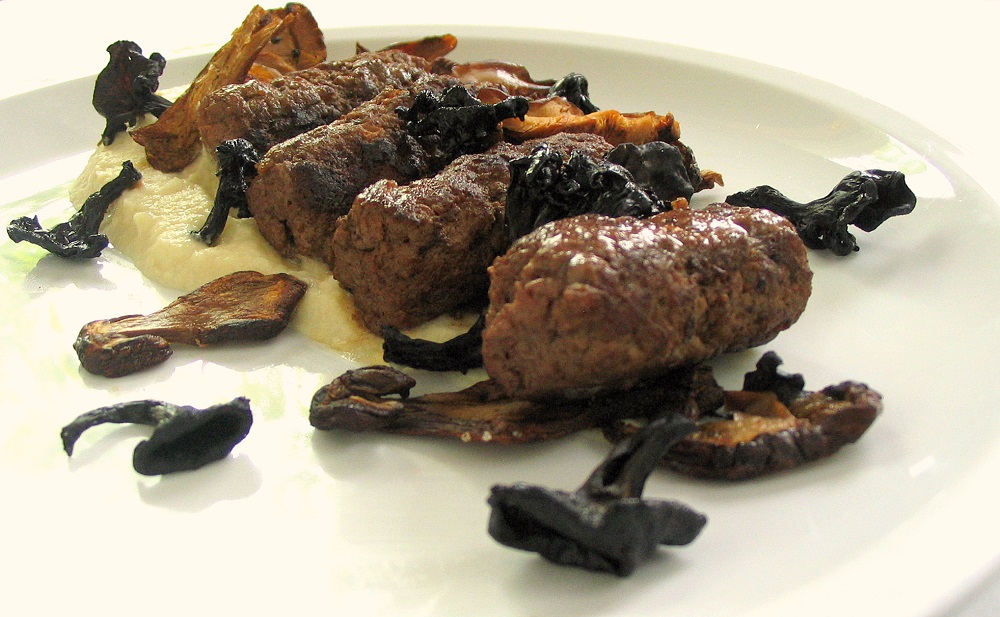
They are classically served in a somun (a kind of pita bread) with chopped onions and often kaymak and this is how they are served in most of Belgrade restaurants. But I was a bit mischievous and I served them with Serbian mushrooms (black trumpet and porcini).
Podeli:


